A night time routine for a tween with a phone
Free 3-page PDF. No email needed.
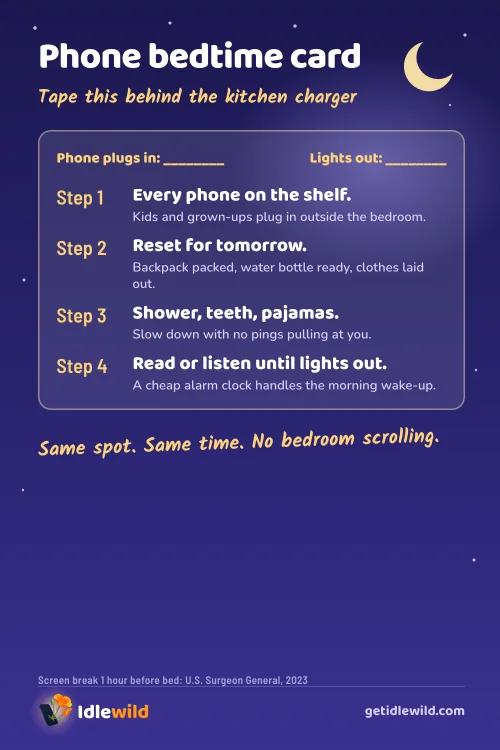
The phone's bedtime card for the kitchen charger
Print this card, write in your family's plug-in and lights-out times, and tape it right behind the charging spot in the kitchen. When the phone has its own bedtime outside the bedroom, the rest of the evening follows a clear track.
- Every phone on the shelf. Kids and grown-ups plug in at the same spot outside the bedrooms, every school night.
- Reset for tomorrow. Pack the backpack, fill the water bottle and lay out clothes before heading upstairs.
- Shower, teeth, pajamas. Wind down without notifications or bright screens pulling at your attention.
- Read or listen until lights out. A book or audiobook finishes the evening, and a cheap alarm clock in the bedroom handles the morning wake-up.
Sources: U.S. Surgeon General advisory, p. 17, 2023 · AAP, Daylight Saving Time: Don't Lose Sleep Over It, 2026
A night time routine for a tween with a phone
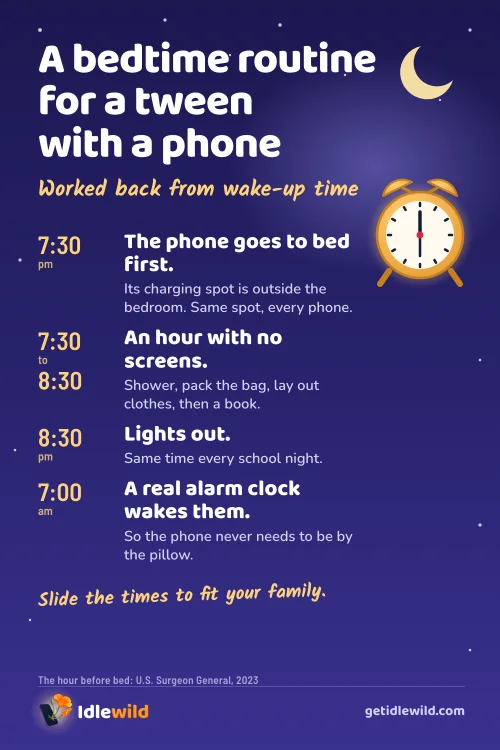
Build the evening backward from the time your child wakes up for school. Here is one sample timeline for a 7:00 a.m. wake-up (10.5 hours of sleep, inside the 9-to-12-hour range for ages 6 to 12); slide every time earlier or later to match your family's morning bell.
- 7:30 p.m. The phone goes to bed first. One hour before lights out, every phone lands on its charger outside the bedrooms, following the one-hour screen break the U.S. Surgeon General suggests.
- 7:30 to 8:30 p.m. An hour with no screens. Shower, pack the school bag, lay out clothes, then spend twenty minutes reading in bed.
- 8:30 p.m. Lights out. Consistent school-night lights out keeps the sleep window intact.
- 7:00 a.m. A real alarm clock wakes them. Giving a tween their own alarm clock removes the usual practical excuse for keeping a phone on the nightstand.
Sources: U.S. Surgeon General advisory, 2023
What time should a tween go to bed?
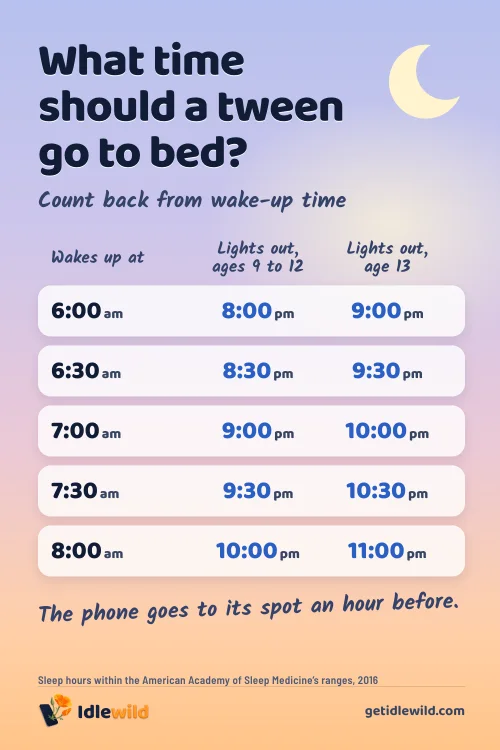
The American Academy of Sleep Medicine recommends 9 to 12 hours of regular sleep per 24 hours for kids ages 6 to 12, and 8 to 10 hours for teens ages 13 to 18. Our printable chart sits inside those ranges at 10 hours for ages 9 to 12 and 9 hours at age 13.
- Wakes at 6:00 a.m. Lights out at 8:00 p.m. for ages 9 to 12, or 9:00 p.m. at age 13.
- Wakes at 6:30 a.m. Lights out at 8:30 p.m. for ages 9 to 12, or 9:30 p.m. at age 13.
- Wakes at 7:00 a.m. Lights out at 9:00 p.m. for ages 9 to 12, or 10:00 p.m. at age 13.
- Wakes at 7:30 a.m. Lights out at 9:30 p.m. for ages 9 to 12, or 10:30 p.m. at age 13.
- Wakes at 8:00 a.m. Lights out at 10:00 p.m. for ages 9 to 12, or 11:00 p.m. at age 13.
In every row, the phone goes to its charging spot an hour before lights out.
Sources: Paruthi et al. / AASM, Recommended Amount of Sleep for Pediatric Populations, 2016
Why does keeping the phone out of the bedroom matter most?
Research points closely at screen use after getting into bed. In a 2024 JAMA Pediatrics study that filmed 79 youths ages 11 to 14 across 323 nights, total screen use during the two hours before bed was unrelated to most sleep measures, while interactive screen use in bed showed the clearest sleep drops: each extra 10 minutes of in-bed gaming was associated with 17 fewer minutes of sleep, and nights with multitasking were associated with 35 fewer minutes.
A larger meta-analysis across 20 studies of 125,198 children ages 6 to 18 also linked bedtime portable device access and use with poorer sleep outcomes. Moving the charger to the kitchen settles bedroom access once instead of fighting over willpower under the covers.
Sources: Brosnan et al., JAMA Pediatrics, 2024 · Carter et al., JAMA Pediatrics, 2016
A phone that's off on time without you
A kitchen charger handles where the phone sleeps, while a calm device all afternoon makes putting it down at 7:30 p.m. much less of a tug-of-war.
Idlewild is an iPhone and iPad app we're building so the phone stops pulling before bedtime even starts: pages that end, no autoplay, scheduled evening wind-down, and pages that turn red 30 minutes before bedtime.


 Idlewild